

NSF-REU
Research Experiences for Undergraduates: NSF Summer 2024 Research Program - Proposal Has been Funded!!!
Why Participate in the REU Program?
- Our program provides each student with an exciting opportunity to do cutting-edge research. Possible areas of research include astronomy/astrophysics, atomic physics, biological/Health/Medical physics, condensed matter physics, materials science, and plasma physics. Students may work on computational, experimental or theoretical problems.
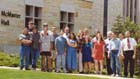 Our students work directly with faculty members. The faculty member provides background information about the area in which the
student is working as well as detailed guidance about how to work on the student’s
individual problem. This regular contact with the faculty is very valuable. Unlike
other programs in which REU students rarely see the faculty and only work with a postdoctoral
research associate or a graduate student, our program places a high value on the personal
interactions of the REU students with the faculty. The link below will direct you
to thumbnail sketches of the research interests of our faculty. Faculty Research
Profiles
Our students work directly with faculty members. The faculty member provides background information about the area in which the
student is working as well as detailed guidance about how to work on the student’s
individual problem. This regular contact with the faculty is very valuable. Unlike
other programs in which REU students rarely see the faculty and only work with a postdoctoral
research associate or a graduate student, our program places a high value on the personal
interactions of the REU students with the faculty. The link below will direct you
to thumbnail sketches of the research interests of our faculty. Faculty Research
Profiles - The opportunity to work on the research frontier while still an undergraduate student is unique. The work is challenging, but the rewards are tremendous. You will be working on your own project in the field of your choice. You will be the first person to work on this problem and your results will be of interest to the entire scientific community.
- There can be no greater thrill for a scientist than to discover something new. Our students have this opportunity and many have contributed new and fundamental knowledge to the world of science. Many of our students publish their findings in the refereed literature. Many of them also present their research at a professional meeting. The students have the opportunity to discuss their research with the scientists working in their area. They also learn many new things at such meetings. It is an exciting experience to learn that one can participate in the highest level discussions about their chosen area
- Another benefit of such interactions is that the student gets to meet the "big shots" of their chosen scientific area. Making contact with these people is exciting and invigorating! Such contacts are also very useful, particularly when one is trying to decide which graduate school to attend.
- Undergraduate research is a very useful experience since it teaches you how to ask the right questions. This is an enormously important skill and, like riding a bicycle, can only be learned by doing. The regular classroom courses which every student takes provide an excellent education to understand the framework of scientific knowledge. However, these courses teach you how to generate the right answer, they don't teach you how to ask the right question.
- REU participants will receive a stipend of $7000.00!
What areas of research can you explore during the Physics & Astronomy REU program?
Click on this link to see the Annual Report of the 2021 REU Summer program.
Click on this link to see the Annual Reports of the 2022 and 2023 REU Summer programs.
How to apply to the 2024 REU Program?
- Must be a US Citizen.
- Fill out and submit the application form by clicking this link.
- Email an unofficial transcript from your home institution.
- Have two letters of recommendation sent to our program.
- Have a 10 week window starting from May 27th until August 2th to do research in an available area of science of your choice at the UToledo Physics and Astronomy Department.
- Applications will be accepted up to and including April 29, 2024.
Flyer for the Summer 2024 REU Program
COVID-19 note:If it is deemed unsafe to run this program in person, it may be shifted to a virtual program over the same dates.
Previous REU Programs
You can review a snapshot of the 2021 NSF-REU program by clicking this link.
You can review a snapshot of the 2022 & 2023 NSF-REU summer programs by clicking this link.
For any questions pertaining to the REU program contact Dr. Rick Irving via email address: REU-PhysicsAstro@utoledo.edu.