


Robert S. Crissman, Ph.D.
 |
 |
Associate Professor |
| Office: 120A Block Health Science Building | ||
| Tel: 419-383-4120 | ||
| Fax: 419-383- 3008 | ||
| Email: robert.crissman@utoledo.edu | ||
| Education: |
|
1967 B.S. Biology - Baldwin-Wallace College, Berea, OH |
| Research Interests: |
|
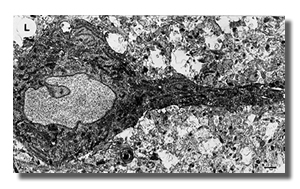
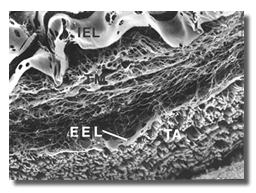
In the past my bench research has focused on bone development, fine structure of myocardial
infarction, elastic component of blood vessels and skin. My last research was in developmental
neurobiology for 14 years.
|
 better science teachers who have experience basic research. Teachers develop a science
teaching module that they introduce to their class during the following year and have
the class visit the research lab they worked in for the summer.
better science teachers who have experience basic research. Teachers develop a science
teaching module that they introduce to their class during the following year and have
the class visit the research lab they worked in for the summer. | Teaching Interest : |
|
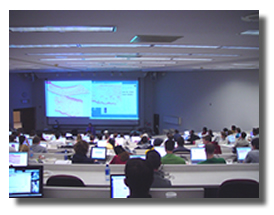
In addition to teaching first year medical students gross, microscopic and developmental
anatomy in lectures and labs of the integrated courses of Molecular & Cellular Biology
(Block I), and Human Structure & Development (Block II), I facilitate in the problem-based
pathophysiology course throughout the year, participate in the Med START program for
incoming medical students during the summer and lecture in the graduate school course
of Molecular & cellular Biology. |
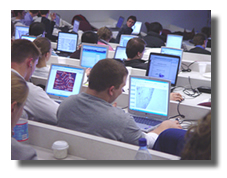 tive Instruction and includes extensively labeled diagrams, illustrative micrographs
of tissues and animated illustrations of the processes that occur within living bone
tissue. This self directed program is complete with voice-overs, written descriptions
of structures, embedded questions and animations that can be used by first and second
year students as well as residents. Further development will include animations of
actions of hormones, diseases and drugs. Limited examples of the program are available
by clicking on the icon below.
tive Instruction and includes extensively labeled diagrams, illustrative micrographs
of tissues and animated illustrations of the processes that occur within living bone
tissue. This self directed program is complete with voice-overs, written descriptions
of structures, embedded questions and animations that can be used by first and second
year students as well as residents. Further development will include animations of
actions of hormones, diseases and drugs. Limited examples of the program are available
by clicking on the icon below. | Publications |
|