


2026 State of the University address
President Holloway Charts Next Chapter in State of the University Address
October 22, 2026
University of Toledo President James Holloway is planning for growth to strengthen the University’s impact on Northwest Ohio, setting ambitious goals for enrollment, research funding and patient care in his State of the University address.
Speaking Oct. 22 in Doermann Theatre, Holloway outlined the Growing for Toledo strategic plan, which calls for UToledo to reach 16,000 students, $100 million in annual research expenditures and 140,000 primary care patients by the end of 2031.
Holloway thanked faculty, staff and students for their work and said the University’s mission remains vital to the region.
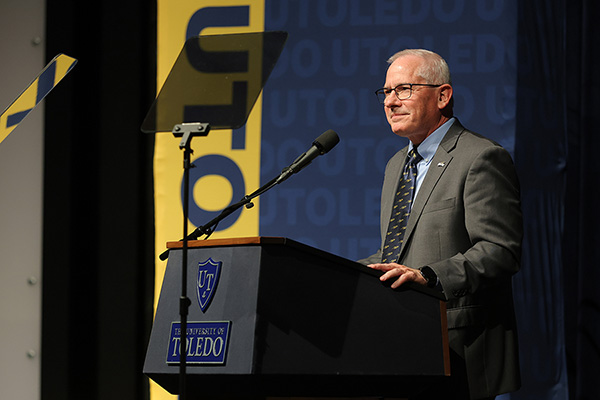
“This University is important,” he said. “What we contribute to the great national project of higher education and health care is critical.”
A Strategy for Growth
Holloway acknowledged mounting challenges for both sectors, including public skepticism about higher education’s value, strained funding models and questions about how artificial intelligence will change the need for human expertise.
But he argued that retrenchment is not the answer.
“Growth creates opportunity. Growth creates knowledge. Growth creates impact,” he said.
Approved by the Board of Trustees and announced three weeks ago, Growing for Toledo builds on the University’s Advantage Toledo, Innovate Toledo and Healthy Toledo launchpads. Five strategic pillars organize the work:
- Realize the UToledo Advantage – focused on student opportunity and outcomes
- Drive Research & Innovation – supporting discovery, applied learning and economic development
- Build for a Healthy Toledo – aimed at the health of our community
- Engage Our Partners – recognizing the importance of regional collaboration
- Optimize Our Institutional Systems – concentrating on efficiency and effectiveness
Holloway underscored UToledo’s role as Northwest Ohio’s only R1 research university and only academic health system. The University has an annual economic impact of about $3 billion, graduates about 3,700 students annually and treats over 100,000 patients every year.
But he emphasized that growth is not simply about getting bigger. It is about expanding UToledo’s reach and securing the resources to sustain its mission.
“We should be known not for who we exclude, but for who we welcome into the world of higher learning,” Holloway said.
The plan sets three primary measurable goals:
- Enrollment: Reach 16,000 students by fall 2031, with somewhat greater growth among graduate students than undergraduates.
- Research: Increase annual research expenditures from about $76 million to $100 million by expanding interdisciplinary research, industry partnerships and funding sources.
- Health care: Expand primary care to 140,000 people, about 40,000 more than today, through additional clinical locations, reorganized services and increased capacity to train health care workers.
Achieving the plan’s goals, he added, will require collaboration, student- and patient-centered decisions, financial discipline and a willingness to change.
Early Signs of Momentum
Holloway pointed to several indicators and initiatives already advancing the plan.
He cited encouraging fall enrollment figures as evidence of progress including a 2% increase in new students in UToledo degree programs. Persistence among students who entered in 2024 also reached an all-time high. He also noted UToledo’s recognition as a Top Performer in Social Mobility and the University of Toledo Medical Center’s increasing market share.
Starting this fall, every UToledo student, regardless of major, will complete an experience-based learning activity prior to graduation. The Office of the Provost has launched the ASCEND office to support that commitment, a defining characteristic of the UToledo Advantage.
The University also recently announced the Rocket Research Acceleration program, which will help researchers develop discoveries into sustained research programs and compete for major external funding.
“We are investing in capacity, rather than simply in discrete projects,” Holloway said.
Meanwhile, UToledo’s academic health system has a number of initiatives already underway, including the expansion of clinical locations.
‘Actions Can Change the Outcome’
Holloway closed by urging an optimistic outlook. “Optimism is not the belief that success will be easy,” he said. “Optimism is the conviction that our actions can change the outcome.”
He said the University will be measured by enrollment, research funding, patient volumes and financial performance, but “ultimately, a great university is measured by the opportunities it creates, the lives it changes, the discoveries it makes and the communities it serves.”
He also thanked the faculty, staff and students who are already working to put the plan into action.
“The future of The University of Toledo will not be built by a plan. It will be built by people,” Holloway said. “It will be built by the faculty who inspire learning and lead discovery, by the staff who recruit our students and keep us operating, by the healthcare workers who treat the sick, by the students who place their trust in us, and by the community that believes in our mission.”
“It will be built by you,” Holloway concluded.
Full details of the strategic plan are available at the Growing for Toledo strategic plan site.