


Melissa Ledesma-Leese '01
"Yes, and"
by Kate Abu-Absi | Oct 21, 2026
The first rule of improvisation is to always respond with "Yes, and." No matter what your scene partner says or does, it is your job to agree and help move the scene forward. If you are an actor, that rule is in your DNA, but it does not hurt to approach the curveballs that life throws your way with the same openheartedness. Our featured alum, Melissa "Missy" Ledesma-Leese ’01, has done just that. She met challenges with a willingness to try something new, stared down life's messiness without blinking, and used her natural zest for life to embrace the adventure.
Growing up in Perrysburg Heights, Missy dreamed of a life as an actress, but, from a working-class family, she chose to minor in Theatre rather than major in it during her undergraduate studies at Bowling Green University. Broadway was always the end goal, but then she was cast as the lead in the play ¿De Donde?, and through that experience, gained a much greater understanding of the complicated and demoralizing experiences immigrant communities face while navigating the political asylum process. The role deeply affected her, and at that time her ambitions shifted toward law.
Although there were out-of-state schools that accepted Missy, an ailing grandmother being moved to hospice kept her close to the area, and the University of Toledo College of Law became her home for 3 years starting in 1998. Like all law students, those years were a blur of studying and trauma bonding with her classmates, but as a military wife, Missy also dealt with lengthy separations from her husband, Rob. Just in case that was not enough stress, she then discovered that she was unexpectedly pregnant days before taking the bar exam. Chin up, she persevered and took her first legal job at Lutheran Social Services, working with people applying for asylum, joined her husband in Washington, D.C., and entered the ranks of a 2-income family, working toward the American dream.
Working at an organization that depended on government-subsidized funding had not seemed risky, but after 9/11, everything changed. That job disappeared and, needing work, Missy began a new chapter as a civil service officer working as an asylum officer for the Department of Homeland Security. Eventually, she joined the Department of State as a Consular Officer. Rob deployed to Afghanistan for a year and then to a post in Italy, where Missy and their son joined him. Once he was able to retire, the international travel bug bit again with an opportunity for Missy to take a foreign service position as a Consular Section Chief in Lesotho, Africa, and this time the family followed her.
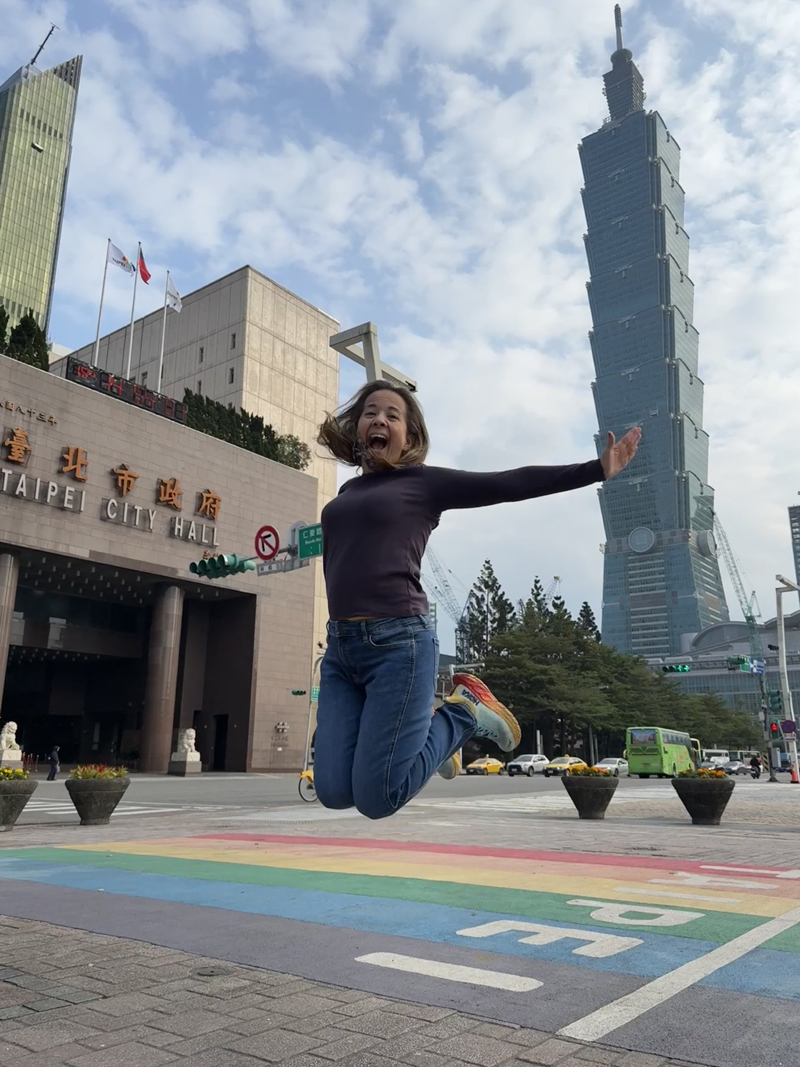
From the stories Missy shared, I think it would be safe to say that the work of an American diplomat is never boring and never done. Still with the State Department, she, her husband and her 89-year-old father-in-law are currently in Taiwan as she serves as the Deputy Human Resources Officer at the American Institute of Taiwan. Her son, who had more stamps on his passport than most people reading this, is holding down the fort at their home in D.C. while he finishes his master’s in arts management at George Mason. And who knows what is next? A quiet retirement in the states, another foreign service posting, regardless I suspect Missy will be ready to respond "Yes, and."
Q&A with Melissa Ledesma-Leese
Brief biography
Melissa Ledesma-Leese began her Department of State career as a training coordinator
for the Office of Fraud Prevention Programs in Consular Affairs. She served as Consular
Chief for the Embassy in Maseru, Lesotho. She served as Chief of Staff for the Director
General of the Foreign Service and Bureau of Global Talent Management. She was Deputy
Advisor of the Diversity and Inclusion Unit and later Deputy for the Retention Unit
for the Department of State. She currently serves as a Human Resources Officer at the
American Institute in Taiwan.
When did you begin thinking about law as a career?
I think I considered it early on since I have a second-grade paper from school listing
“lawyer” as what I wanted to be when I grew up, but it wasn’t until my undergraduate
days when I was cast in the lead role in a theatre production called “De Donde?”-Spanish
words for, “Where are you from?” This play prompts the audience to explore the human
cost of immigration policies, while also serving as a plea for understanding and compassion.
It is at this time that I decided to apply and enroll in law school.
Did any particular experiences lead you to pursue law school?
Prior to joining the Department of State, I worked as an asylum officer. In that role,
I routinely used the Department's Human Rights Report, which inspired my career shift:
"I remember thinking, I want to do that! Luckily, I found a great fit when I went
to work for Consular Affairs.
If you are a first-generation college or law student, has that had any impact on your
experience in law school or in your career?
Growing up in Perrysburg, OH as both a first-generation college and law student, I
entered higher education without a traditional roadmap, a perspective that ultimately
defined how I view public service. Lacking a pre-established professional network
forced me to rely on adaptability and resilience, skills I quickly learned from waiting
tables and teaching junior high before navigating law school. Rather than seeing my
background as a limitation, I realized it gave me a unique capacity to connect with
people from all walks of life. This firsthand understanding of navigating unfamiliar,
complex systems directly shaped my legal advocacy work and my journey to the Department
of State. Ultimately, being the 1st in my family to pursue these degrees taught me
that diverse, nontraditional backgrounds are not just valuable; they are essential
for bringing fresh perspectives to global talent management and public diplomacy.
How did you decide on Toledo Law for your legal education?
After going to Spain for a study abroad year in undergrad, I was broadening my horizons
when selecting law schools. I had been accepted to other law schools out of the area,
but when I learned my maternal grandmother was diagnosed with cancer, a woman who
raised me just as much as my parents, I knew I needed to stay close. I have never
regretted that decision both for my family and for my education.
Do you have a favorite memory from attending Toledo Law?
It’s funny, my favorite memories are also my most stressful memories. It would be
studying for exams. I had two very close groups of friends, that I am proud to say
have become lifelong friends. It seems like the silliest memories I have are from
forming human pyramids and poking fun of our professors during our study breaks. My
husband is a retired military officer and I would never compare what I did to his
career, but I feel like the camaraderie and bond one forms in law school is similar
to that of basic training. You rely on each other, you support each other all due
to the shared experience.
I do have a couple memories that I hold fondly. I remember first year in law school it was my civil procedures class with Professor Richman and when he called on me, he asked me my name and when I said, “Missy Ledesma-Leese,” he said that that was too long so which last name did I prefer. I told him he was asking me to choose between my married name and my family name and that was impossible. He said, “Fair enough I'll just call you 2L.” The funny part about that, if you don't know, law school is a 3-year program so as a first year, being called 2L was a welcome nickname. Ironically, it stuck and many people didn't remember my actual name and I was called 2L for a while. This memory strikes me as especially poignant because even then, it was very important to me to stay connected to my family whether it be my husband or my biological family. That stands true today.
What did you find difficult about your time in law school?
Let’s not mince words, law school was one of the hardest things I have ever done.
I admire those who were able to slide through just like it was the next level from
undergrad, and some of them were part of those close knit circle of friends that I
mentioned before, but for me I worked my butt off. The hardest part was I felt like
I was studying ALL the time. I missed family gatherings because I would feel guilty
if I wasn’t spending my time in a book. Yes, I said book, remember when studying meant
reading books? They weren’t tablets or desktop screens, they were 20 pound books.
My last year in law school was the hardest because my husband had received his commissioning
and so we were geographically separated for that last year. That was rough.
What law school experiences helped shape your practice area/career path?
The work I did with ProBar, an American Bar Association funded organization that provided
asylum advocacy in Harling Texas, and Advocates for Basic Legal Equality (ABLE), a
non profit that provided legal services for low-income refugees and immigrants, were
two opportunities that really shaped the kind of work I wanted to do. I knew I was
never going to work for a big corporate law firm tracking billable hours, I deliberately
chose a path that would bring that legal foundation directly to the people that needed
it.
What was your first position after law school? How did you find it?
My first job out of law school was running the immigration team for a non-profit asylum
advocacy center. Throughout law school, I had clerked for various nonprofits, thanks
to the Public Interest Law Career Fair they held every year in Washington, D.C., called
NAPIL. This introduced me to the community and many of the big name players in that
field, so it kept me in the loop when it came time to look for a full time job.
Do you have any suggestions for law students/new lawyers interested in a similar career
path?
There is no one cookie-cutter path to a particular job. We all bring different perspectives
and experience to the table, and you might be exactly what that office or hiring manager
is looking for in their new employee. The Department of State thrives on the collective,
diverse experiences of its team. Don’t back away from sharing what makes you different,
I promise you, that is exactly the missing piece to their puzzle. Also, don’t dismiss
the opportunities that a law degree can provide you. You may have a concrete picture
in your head with what the finish line looks like after law school, I know I did.
Perhaps, you imagine yourself in the end scene of A Few Good Men or To Kill a Mockingbird,
but the fact is there are so many other destinations than a courtroom that your law
degree can take you whether it is negotiating a contract on the other side of the
world or advocating for an individual that was the victim of political persecution.
What do you enjoy doing outside of work?
I love the theatre; I have been lucky enough to find theatre in all parts of the world,
mostly from the audience, but in some countries I have even gotten to perform onstage,
and it has been amazing to find that common ground and how it manifests in so many
different cultures. I love to travel with my husband and son.