


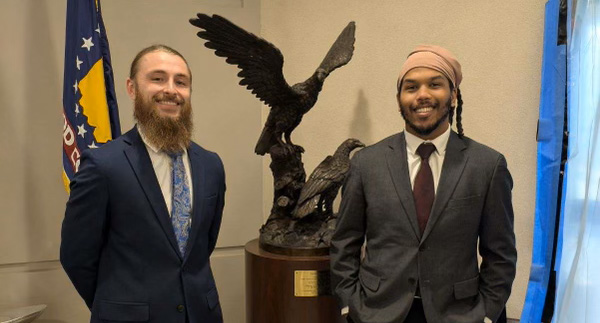
Clif Porter '24 & Noah Woods '24
The New Guard
by Kate Abu-Absi | January 16, 2026
- According to the National Alliance to End Homelessness, on a single night in January 2024, there were enough emergency beds for 68% of individual adults experiencing homelessness in Ohio.
- On December 1, 2025, the body of 61-year-old Richard Kwapich IV was found in the snow in downtown Toledo. His cause of death was hypothermia.
- Today, January 16, 2026 , it feels like 15°; 34° during the day, dropping to 17° at night.
College of Law alums, Clifton Porter ’24 and Noah Woods ’24, have their eyes wide open and make a daily choice to not look away from the most vulnerable and least powerful members of our society. Their work is specifically with individuals and communities combating housing insecurity, Clif at The Junction Coalition, and Noah at the Fair Housing Center. They also see very clearly the systems that maintain the status quo and are unapologetically coming for them.
Rather than write an introduction, I am going to let their profile responses speak for themselves. I think it is important to recognize the time to speak and the time to listen, and now is the time to listen. I will leave with this. They are a united front committed to making Toledo a city that doesn’t turn a blind eye to its citizens; they are both educated and uncompromising in their values, and they are today and tomorrow.
Q&A with Clif Porter
Clif grew up in the DMV (DC, Maryland, and Virginia area) until they moved to Maumee,
OH, at age six, before heading to Pennsylvania for college. Clif graduated from Villanova
University in 2019 with a degree in Rhetoric, as a
specialization of Communication, and a minor in Africana Studies. They then returned
in 2021 to obtain their law degree at Toledo Law. Clif’s parents, especially their
mother, Deborah, instilled a love for Blackness in Clif at a young age, which evolved
to include a disdain for inequality, oppression, exploitation, and wealth accumulation
during Clif’s college years at Villanova University. Clif now resides in Toledo with
plans to remain here long term and the intention of creating spaces for like-minded
comrades to do meaningful and impactful work for the benefit of working-class folk
across the region, while continuing to participate in such work on a daily basis.
Clif currently serves as a Housing Manager at The Junction Coalition, A local non-profit, community organization that serves low-income families in a predominantly Black neighborhood.
How did you decide on Toledo Law for your legal education?
I was living in Alexandria, VA, working at a restaurant down the street from my parents’
home while applying to law schools. A woman with a (419) area code came in, and I
told her I had just been thinking about applying to UT Law. It turned out that she
was a UT Law alum, and she gave the university a glowing recommendation. I applied
and was accepted, but I was hoping for more scholarship funds. The final decision
to attend Toledo came when I was told that Pete Kadens had donated funds to the university
to bring diverse perspectives to the legal field. I researched the funding source
and accepted the scholarship, returning to my hometown!
What are some of the struggles you have encountered in your career, and how did you
navigate them?
One struggle in any career is balancing your morals and values with those things you
are required to do to keep your job. Although I’ve never been asked to do anything
illegal, of course, I’ve been asked to do things that did not align with my beliefs,
both in the legal and non-profit fields. Though the decisions can feel massive and
terrifying, I’ve found that standing on my principles has only ever led me to where
I’m meant to be; the real question has only ever been, “How much discomfort are you
willing to handle until you get there?” Put succinctly, the struggle of which I am
most constantly aware is the struggle to lower my tolerance for those things that
don’t align with my principles and increase my tolerance for the discomfort that comes
with standing on business.
Do you have any suggestions for law students/new lawyers interested in a similar career
path?
Too many folks come into law school thinking, “I’m going to change the legal landscape
of our country.” The result is, most often, an individual who is so focused on gaining
power and influence, so that they can enact the large-scale change they envision,
that the person loses sight of the whole point of having the power, in the first place.
My suggestion to law students and recent graduates is to prioritize the impact, not
power. If you prioritize power, you will inevitably make compromises along the way,
in order to acquire that power; this is a habit that is incredibly difficult to break,
especially from a place of comfort. When you prioritize impact, even if power eventually
comes along, you’ve created a pattern of impact over benefit. Contribution over compensation.
People over property.
What do you enjoy doing outside of work?
Outside of work, I am passionate about the outdoors, fiction writing, and video games.
I am an avid forager, and love to look for mushrooms, harvest mullein leaves, and
wildflowers for food and medicine. Along with foraging, I love to fish at any given
opportunity. I also occasionally write short fiction stories with my friends to sharpen
my imagination and writing skills. Other than leisure, I spend my time outside of
work organizing with friends and comrades with similar convictions, passions, and
goals. We organize together, with the communities we seek to serve, to provide resources
and to educate the masses and ourselves.
Q&A with Noah Woods
Noah Woods joined The Fair Housing Center (TFHC) as a staff attorney in May 2024 after graduating magna cum laude from the University of Toledo College of Law. He was admitted to the Ohio Bar in November 2024 after successfully passing the July 2024 Uniform Bar Examination.
Prior to law school, Noah graduated summa cum laude from Indiana State University’s Honors College, earning a B.S. in Political Science with minors in economics and civic leadership. During law school, he gained hands-on experience as a summer fellow with the Piedmont Environmental Council in Warrenton, Virginia, and as a summer associate with Advocates for Basic Legal Equality in Toledo. In his final year, Noah interned with Legal Aid of Western Ohio’s Right to Counsel practice group, where he assisted tenants facing eviction proceedings.
At TFHC, Noah primarily represents tenants dealing with housing condition issues. His work includes providing free legal consultations, representing tenants in rent escrow actions, and collaborating with community partners to advance policies and programs that promote inclusive and equitable housing in Toledo. He is also actively involved in fair housing education and community outreach, working alongside organizations such as The Junction Coalition and the Toledo Lead Poisoning Prevention Coalition.
What law school experiences helped shape your practice area/career path?
Upon graduating from the University of Toledo College of Law, I accepted a staff attorney
position at The Fair Housing Center (TFHC), where I continue to work today.
I first became familiar with TFHC during my first year of law school through the Student Bar Association’s Pro Bono Committee. In that role, I helped develop a fundraising event, Strike Out Discrimination, which has since become an annual event and has raised more than $6,000 in support of TFHC’s work.
During my second year, I enrolled in an elective Fair Housing Law course taught by TFHC’s President and CEO, George Thomas. That course deepened my interest in housing-related issues generally, and fair housing advocacy in particular.
As a third-year student, I stayed connected with both Mr. Thomas and TFHC by seeking his advice and continuing to organize SBA’s annual Strike Out Discrimination fundraiser. Those relationships ultimately led to the opportunity to join TFHC as a staff attorney after graduation.
What are some of your career highlights?
Some highlights from my first full year of practicing law include:
- Serving as the primary author and oral advocate on a successful appeal before the Sixth District Court of Appeals (Booker v. RSH 506 LLC), as well as the primary author of another successful appeal (Rose & Esmond v. Bennett).
- Representing a tenant in an eviction proceeding that resulted in dismissal of the eviction and successful counterclaims, ultimately securing a settlement of more than $6,000 for my client.
- Helping secure more than $100,000 in rent abatement awards for TFHC clients in 2025.
What have you found most satisfying about your career thus far?
What I have found most satisfying about my career thus far is the opportunity to work
at both the individual and systemic levels. On a day-to-day basis, I can directly
assist individuals and families facing housing instability to help preserve their
housing and achieve greater stability during incredibly difficult moments in their
lives. With the ongoing affordable housing crisis, the need for this work is immense.
Housing is a basic human need and, in my view, a fundamental human right. It is deeply
fulfilling to play a role in protecting that right for my clients.
At the same time, I am motivated by the opportunity to address the broader, systemic forces that contribute to housing insecurity in the first place. The current housing crisis did not arise in a vacuum; it is the product of longstanding policy failures and a legacy of structural inequities, including systemic racism. Meaningfully addressing these challenges requires more than individual representation; it also requires advocacy for policy reform, support for grassroots and community-led efforts, and collaboration across disciplines. Being able to contribute to both aspects of this work is what makes my career especially meaningful to me.
Do you have any suggestions for law students/new lawyers interested in a similar career
path?
Get connected early - If you’re interested in public interest law, don’t hesitate
to reach out to organizations or individuals whose work inspires you. Introduce yourself,
share why their work resonates with you, and ask about ways to get involved. In my
experience, people working in public interest law are deeply passionate about what
they do and are often eager to support others who share that commitment.
Get involved - Many nonprofit and legal aid organizations lack the resources to offer paid internships. If you are financially able to pursue an unpaid opportunity, doing so can be a valuable way to build relationships that may later lead to paid positions. Connections matter in every sector, and one of the best ways to make them in public interest law is by volunteering, especially at legal clinics hosted by the Toledo Bar Association and local nonprofits.
Be open to opportunities - While it’s helpful to have a general sense of the type of work you want to do, stay open to opportunities in areas you may not have initially considered. Public interest work often overlaps across issue areas. I entered law school interested in environmental law, and while that interest remains, my current work has shown me how closely environmental justice and housing issues intersect.
Please share anything else that is important to you, and you would like included in
your Profile.
For law students and attorneys interested in public interest or social justice work,
I encourage learning about the principles of movement lawyering. This approach to practicing law recognizes that lawyers play an important role in
advancing social change, but that legal advocacy alone is not sufficient. Lawyers
are one part of a much larger movement ecosystem that includes community organizers,
directly impacted individuals, and grassroots movements.
Movement lawyering emphasizes working in partnership with communities rather than leading them; supporting, rather than directing, grassroots efforts. By centering the goals and leadership of those most impacted, lawyers can better utilize legal tools as a means of advancing collective liberation. This framework has strongly influenced how I approach my work and how I understand the role of the legal profession in pursuing lasting social change.
As famed civil rights attorney Charles Hamilton Houston once said, “A lawyer is either a social engineer or a parasite on society.”