


ERRL: Current Projects
Modeling Flow Dynamics Through Wetland Mesocosms
Located at the Stranahan Arboretum, six wetland mesocosms have been constructed for the study of contaminant fate and transport in treatment wetlands. These mesocosms, measuring 20' x 4' x 4', allow for pilot-scale replication in wetland studies. Matt Gorr will be modeling the movement of water through soil in several mesocosms, ensuring that variables such as soil packing and porosity are uniform across the cells to allow for reproducible results. The model generated from this experiment will be used in future studies dealing with specific contaminants, such as arsenic, pharmaceuticals, and pathogens.
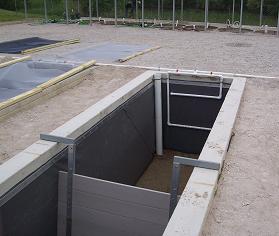
Wetland test
cell located at the Stranahan Arboretum
Inspring 2009, these cells will be packed with soil and dosed with the conservative
tracer, sodium bromide. Soil moisture probes and
pore water samplers will be placed strategically throughout the soil to monitor the
movement of bromide through the cell. Soil cores will
also be taken pre- and post-dosing to compare bulk density and porosity.
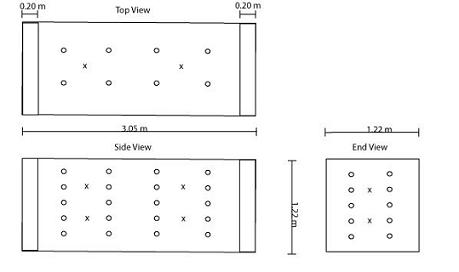
Os denote placement of pore water samplers and Xs denote placement of soil moisture
probes
A scaled-down version of this experiment is currently being implemented to determine maximum dosing time and sampling intervals for the larger experiment.
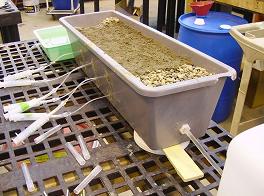
Microcosm study
being performed in the
Plant Science Research Center greenhouse