


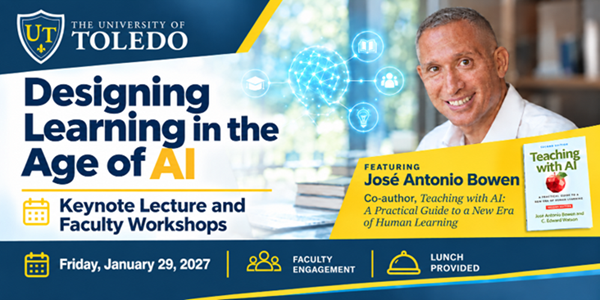
Designing Learning in the Age of AI with José Antonio Bowen
 Register Now!
What Can I Expect?
Join Dr. José Antonio Bowen and UToledo faculty for a day of engaging discussion, hands-on learning, and practical strategies for using artificial intelligence thoughtfully in higher education.
The keynote will explore research on AI’s impact on student learning and how faculty can design assignments and assessments that strengthen critical thinking, reasoning, and engagement. In two interactive workshops, participants will practice using AI tools, develop effective prompting techniques, and explore applications for research, teaching, and everyday faculty work. The afternoon workshop will emphasize creative, customized assignments and AI-powered learning resources that support students without replacing their thinking.
Participants will leave better prepared to:
- Use AI tools and prompting techniques effectively.
- Critically evaluate AI-generated content and recognize its limitations.
- Design assignments and assessments that promote meaningful learning.
- Develop AI-powered resources that support student learning and agency.
- Consider equity, inclusion, and engagement when incorporating AI.
- Make informed choices that preserve academic rigor and human judgment.
Friday, January 29 | Student Union 2582/84
8:00–9:00 a.m. Leadership Roundtable: Leading through the AI Transformation
(Invitation only event)
Moderated conversation and Q&A with Dr. Bowen, UToledo Academic Leadership and members
of the AI Task Force, touching on strategic leadership and the opportunities and challenges
AI presents for higher education.
9:15–10:30 a.m. A Research-led Approach to Designing Learning in the Age of AI
Keynote Address by Dr. José Antonio Bowen
There is now a body of verifiable research on when AI is harmful or supportive of
durable student learning. Without our intervention, student use is unguided and homework
improves, but exam scores fall. This is partly because AI disrupts self-assessment.
Further, the most common student use of AI is summarizing, but learning requires synthesis,
so the most popular use of AI is a learning trap. But we also have good research that
demonstrates how purpose-built AI tools that withhold answers (and are often customized)
have produced learning gains. The key is to make desirable difficulty unavoidable
and measure reasoning,
not artifacts. Current research, therefore, strongly supports a new set of principles
for designing better assignments and assessments (with or without AI) for this new
era of human learning.
A presentation aimed primarily at faculty on AI, teaching, and higher education.
10:45 a.m.–12:00 p.m. Workshop I: Working with AI: Tools and Techniques
AI Literacy begins with knowing which AI tool to use but then requires asking better
questions and evaluating responses: extensions of the critical writing and thinking
skills we already teach and value. AI prompts need human context, but AI also has
new capabilities:
AI can search for ideas and expand perspectives. Prompting is not engineering; prompting
is writing. In this interactive workshop, you will get to practice lots of techniques
on a wide variety of rapidly-evolving AI tools. Our goal is to get a realistic understanding
of how AI is already changing human work and thinking and how you might begin to use
it to improve your research and teaching.
• We will explore dozens of AI models, tools and agents.
• We will develop prompting ideas and skills.
• We will practice improving research and other faculty tasks with AI.
12:00–12:45 p.m. Lunch - Ingman Room
1:00–2:45 p.m. Workshop II: Teaching with AI: Customized and Creative Assignments
This practical session will start with the implications of how AI is changing average.
We will examine how we can design assignments (including writing) that will motivate
students to do the hard work only they can do: AI can now customize every assignment
to increase the motivation and effort of every individual student. We will discover
how AI can create materials and will create design activities, simulations and a tutor
bot that can support student learning without providing answers. Our most important
goal, however, is to create assignments that foster and protect critical thinking
and human agency while also raising
standards.
• We will explore the implications of AI customization.
• We will consider how AI help or hurt equity and inclusion on our campus.
• We will create new assignments and student support bots with AI.
• We will understand the implications of agents and vibe-coding.
About the Speaker: Dr. José Antonio Bowen
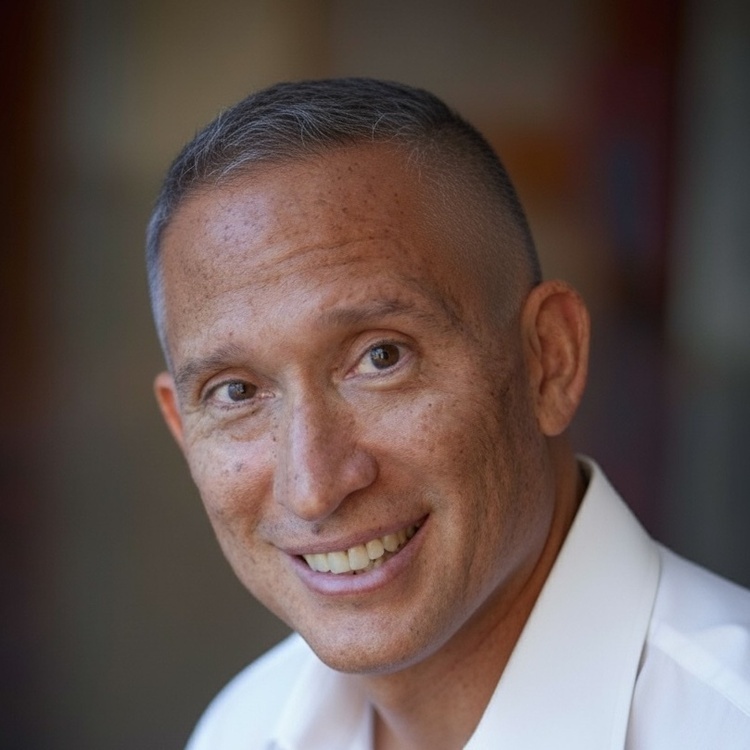 José Antonio Bowen has been leading innovation and change for over 40 years at Stanford, Georgetown,
and the University of Southampton (UK), then as a dean at Miami University and SMU
and as President of Goucher College (voted a Top 10 Most Innovative College under
his leadership). He now runs Bowen Innovation Group L.L.C., and does innovation, pedagogy and D&I consulting and training in both higher education
and for Fortune 500 companies including AT&T, Chevron, Pfizer, Toyota, and Walmart.
As a scholar, Bowen holds four degrees from Stanford University (in Chemistry, Music, and Humanities), has written over 100 scholarly articles, was editor of the Cambridge Companion to Conducting (2003), and an editor of the 6-CD set, Jazz: The Smithsonian Anthology (2011). He received a National Endowment for theHumanities Fellowship and has a TED talk on Beethoven as Bill Gates. In 2010, Stanford honored him as a Distinguished Alumni Scholar.
Bowen is a musician and has appeared on five continents as a jazz pianist and conductor with Stan Getz,Dizzy Gillespie, Bobby McFerrin, Dave Brubeck, Liberace, and many others. His compositions include a symphony (nominated for the Pulitzer Prize in Music in 1985), and music for Jerry Garcia.
Bowen has long been a pioneer in education, classroom design and technology, featured in The New YorkTimes, Forbes, The Wall Street Journal, The Chronicle of Higher Education, Newsweek, PBS News Hour,and on NPR (an extended media list is here). He was given a Stanford Centennial Award for UndergraduateTeaching in 1990 and he has presented keynotes and workshops at more than 400 campuses and conferences in 46 states and 20 countries around the world.
His books on teaching include Teaching Naked (2012) winner of the Ness Award for Best Book on HigherEducation from the American Association of Colleges and Universities, the sequel, Teaching NakedTechniques: A Practical Guide to Designing Better Classes with C. Edward Watson (2017) and Teaching Change: How to Develop Independent Thinkers using Relationships, Resilience and Reflection(2021, Johns Hopkins University Press). His latest book with C. Edward Watson is Teaching with AI: A Practical Guide to a New Era of Human Learning (2024, Johns Hopkins University Press).