


Transfer Assurance Guides (TAG)
What is a TAG?
Transfer Assurance Guides (TAGs) are statewide articulation guidelines—most notably developed by the Ohio Department of Higher Education (ODHE)—designed to ensure that foundational college courses transfer seamlessly between public higher education institutions.
While general transfer policies ensure that credits transfer as elective credit, TAGs go a step further: they guarantee that approved courses apply directly toward degree and major requirements at receiving institutions.
The most comprehensive website regarding TAGs can be found at Transfer Assurance Guides (TAGs) | Transfer Credit Ohio. It’s important to note that the Ohio Department of Higher Education (ODHE) requires all public colleges and universities that have degree programs for which ODHE has established TAGs to identify and receive approval for a course for each TAG.
TAG Approval Process
Determine Missing TAGs
- Go to TAG Definitions & Pathways | Transfer Credit Ohio and click on the appropriate program link.
- At this link, you will find:
- The TAG courses that are required for that degree program
- The Student Learning Outcomes (SLO) for each of the TAG courses
- Go to TAG Approved Courses
- At the “Current Institution” drop down menu, select “University of Toledo"
- At the “Subject Area” drop down menu, select the desired program
- Click on “Search”
- Here you will find the courses for which UToledo has an approved TAG. Compare that list with the list of required courses found in Step #2.
- For the courses that do not have an approved TAG, do the following:
- Determine if you have a course that matches the SLOs. If you do, you may go directly to Submit TAG Information for Approval
- If you do not have a course that currently matches the SLOs, please either modify an existing course or develop a new course that satisfies the SLOs.
- Once you have either identified/modified an existing course or developed a new course, you will be ready to move to Submit TAG Information for Approval.
Submit TAG Information for Approval
- Go to Transfer Assurance Guides (TAGs) | Transfer Credit Ohio and click on the TAG Course Descriptions link.
- Locate a missing TAG identified in Determine Missing TAGs and click on the Submission
Template for Course Equivalency Management System for that course. What you will
find will look like this (it will vary by course):
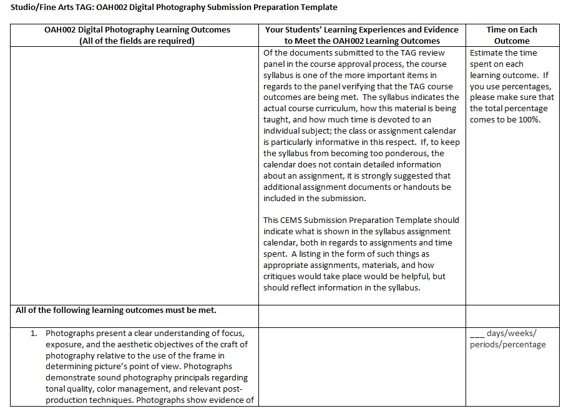
- In the first row you will find an explanation of the submission requirements, as well as the required time-reporting expectations for each Learning Outcome.
- Here is what is needed:
- Copy of the course syllabus—that includes any of the information mentioned in the first row of the template
- Completed template with the explanation of how the Learning Outcomes will be met (middle column) and the time devoted to each Learning Outcome (last column)
- Send the two documents listed above to the Provost Office and label the email “TAG Submission”
- The Provost Office will submit the TAG documents to ODHE (there are two times per year that ODHE reviews TAG submissions—September and February)
OT36
OT36 (formally known as the Ohio Transfer Module or OTM) is a subset of general education courses that are guaranteed to transfer between all Ohio State schools. It is a Statewide transfer initiative that guarantees a subset of our institution’s general education requirements in Associate of Arts (AA), Associate of Science (AS), and baccalaureate degrees will transfer to another State institution within Ohio.
How Does the OT36 Relate to UToledo's General Education Requirements?
Comparison Between OT36 and UToledo General Education Courses
| OT36 Requirements (33 credit hours) | UToledo Requirements (36-42 hours) |
| Composition (3 credit hours) | Skill Area: Composition (6 credits) |
| Mathematics (3 credit hours) | Skill Area: Mathematics, Statistics, and Logic (3 credit hours) |
| Natural Science (6 credit hours including one lab course) | Natural Sciences (6 credit hours including one lab course) |
| Social and Behavioral Sciences (6 credit hours) | Social and Behavioral Sciences (6 credit hours) |
| Arts and Humanities (6 credit hours) | Arts and Humanities (6 credit hours) |
| Additional Elective Credits (9 credit hours) | Additional Elective Credits (9 credit hours) |
| Multicultural: Diversity of US Culture (3 credit hours) | |
| Multicultural: Non-US Culture (3 credit hours) |
More Information on which UToledo courses are approved for OT36 requirements can be found on the Ohio Department of Higher Education website.
Proposing Courses for OT36
Each component of Ohio Transfer 36 has certain required outcomes. UToledo is required to propose general education courses that meet the required outcomes to be included in the OT36, with exceptions made for multicultural courses.
To propose a match, each faculty member will need to assemble the following:
- Detailed and current syllabus with week-by-week schedule, student learning outcomes, assessments, grading distributions from assignments, and final grading scale included as a minimum;
- Course Details Template which includes course number and title, term when course was first offered, credit hours (including contact hours for lectures, labs, and others), pre- or co-requisites, catalog description, textbook ISBN, outside readings and materials, course learning outcomes, description of assessment or evaluation of learning;
- Learning Outcomes Template which includes a list of the required statewide learning outcomes for that component of the OT36, a general description of how the course meets the outcomes (e.g., references to language in syllabus) and a detailed description for students’ learning process (e.g., activities/exercises, specific exam question, assignment) that clearly articulates how the students in that course will meet each State outcome. Note: The OT 36 outcomes cannot be changed.
- Documentation (attachments) which includes examinations, quizzes, homework, assignment prompts or other material referenced in the Learning Outcomes Template.
View course details and learning outcomes templates on Learning Outcomes website.
Once assembled, materials should be submitted as a course modification in the CIM system.